Abstract--Pyrazolo[5,1-b]quinazolines are known to be versatile heterocyclic
compounds with different biological properties because of a large number of
derivatives with different structural modifications. Therefore, some new
Pyrazolo quinazoline heterocycles were synthesized from chalcones and their
structures were confirmed by IR, 1H NMR, 13C NMR and Mass
spectral data. All these synthesized compounds were tested in vitro for their
antimicrobial potential against Gram positive, Gram negative strains of bacteria
as well as fungal strains in dimethylsulfoxide. Among the screened compounds,
KC-10 showed the most potent antimicrobial activity. None of the compound shows
antifungal activity. This may be due to the fact that fungal cells are complex
organisms as compared to bacterial cell. Furthermore, the presence of S-CH3
group in the synthesized compounds may cause inactive behavior of these
compounds against the studied fungal strains.
Keywords-- pyrazolo quinazolines,
antibacterial activity, antifungal activity, agar-well diffusion method,
dimethylsulfoxide
I. INTRODUCTION
Quinazoline derivatives have been of much interest in organic chemistry for a long time because of their wide pharmacological activities (Dangi et al., 2011) such as antibacterial (Bedi et al., 2004; Khalil et al., 2009; Yassin, 2009), anticancer (Ali et al., 2007; Joseph et al., 2010; Zhang et al.,2014), anti-inflammatory (Chandrika et al,; 2008; Kumar et al., 2012), antimicrobial (Patel and Bharat, 2010; Patil et al., 2012; Trivedi et al., 1993), antifungal (Pandey et al., 2005; Pattanaik et al., 1991; Shivananda and Shivarama, 2011) activities, etc. Furthermore, the pyrazolo quinazolines fragment is present in various drug molecules and some biologically active natural products (Kumari et al., 2012). Literature survey shows that quinazoline derivatives also play an important role in drug discovery (Eweas et al., 2013; Helali et al., 2014). Due to these biological properties of quinazoline derivatives, in the present work, some new fused pyrazolo[5,1-b] quinazoline derivatives are synthesized from (E)-2-benzylidene-3,4-dihydro naphthalen-1(2H)-one and their characterization was done by IR, NMR and mass spectral data. The screening of antimicrobial activity of these synthesized compounds was done in vitro against some Gram positive and Gram negative strains of bacteria as well as fungal strains in dimethylsulfoxide (DMSO). The Gram positive bacteria studied were Staphylococcus aureus ATCC29737 (SA), Corynebacterium rubrum ATCC 14898 (CR), Listeria monocytogenes ATCC19112 (LM), Bacillus cereus ATCC11778 (BC); Gram negative bacteria were Pseudomonas aeruginosa ATCC 27853 (PA), Escherichia coli NCIM2931 (EC), Klebsiella pneumoniae NCIM2719 (KP), Salmonella typhimurium ATCC23564 (ST); and Fungi were Candida albicans ATCC2091 (CA), Cryptococcus neoformans NCIM3542 (CN), Candida glabrata NCIM3448 (CG), Candida epicola NCIM3367 (CE).
II. EXPERIMENTAL
A. Synthesis.
Synthesis of
(E)-2-benzylidene-3,4dihydro naphthale ne-1(2H)-one:
Equimolar
mixtures (not equal volume) of
α-tetralone and different substituted benzaldehydes in methanol were stirred
for 1.5 h in presence of catalytic amount of potassium hydroxide (4%). All
the synthesized compounds (KC-1 to KC-10) contain different substituted benzaldehydes
such as 4-Chloro benzaldehyde, 4-methoxy benzaldehyde, 4-Floro benzaldehyde,
4-Bromo benzaldehyde, 3,4-dimethoxy benzaldehyde, 4-cyano benzaldehyde,
3-Chloro benzaldehyde, 3-methoxy benzaldehyde, 3-Bromo benzaldehyde and
4-methyl benzaldehyde. The completion of reaction was
confirmed by analytical thin layer chromatography (TLC) (Performed on aluminum
coated plates Gel 60F254 (E. Merck)) using 7:3 of Hexane:Ethyl acetate as
mobile phase. After completion of reaction, the reaction mass was cooled and
the resulting solid was filtered, washed with water and dried under vacuum to
give a crude product. The obtained crude product was purified by adding
suitable solvent (diethyl ether) to remove colored, nonpolar impurities by
scratching/stirring. The product was then allowed to settle down and the above
solution was decanted. The procedure was repeated 3-4 times to remove
impurities (trituration). The purity of the resulting product was (99.5 %)
0.995 in mole fraction as determined by gas chromatography.
Synthesis of
(5-amino-3-(methylthio)-1H-pyrazole-4-carbonitrile:
A
mixture of malanonitrile (0.01 mmol) and dry K2CO3 (0.012
mmol) were stirred in dry DMF at room temperature for 30 min. To this reaction
mixture, 0.02 mole of carbon disulphide was added drop wise and the resulting solution
was stirred for 2.5 h at room temperature. The solution was then cooled at 0 to
50C. To this cooled solution, 0.02 mole dimethyl sulphate was added
and the solution was again stirred for 5-6 h at room temperature. The progress
of the reaction was monitored by thin layer chromatography. After completion of
the reaction, it was poured into crushed ice to give solid product. The
resulting solid was filtered, washed with cold water and dried under vacuum to
give crude product.
Equimolar solution of this crude product and hydrazine
hydrate in isopropyl alcohol (IPA) was refluxed for 30 min. The reaction
mixture was then poured into crushed ice. The resulting solid was filtered,
washed with water and dried under vacuum to give product. In order to remove non polar impurities, the obtained product was
purified by trituration with hexane and was used in
the next step without further purification.
Synthesis of pyrazolo[5,1-b] quinazolines:
An
equimolar mixture of (E)-2-benzylidene-3,4-dihydronaphthalen-1(2H)-one and
(5-amino-3-(methylthio)-1H-pyrazole-4-carbonitrile) were refluxed in n-butanol
for 4-5 hrs. The completion of reaction was confirmed by Thin Layer
Chromatography using (6:4- Hexane: Ethyl acetate) as a mobile phase. The
reaction mixture was then allowed to cool and the resulting solid was filtered,
washed with diethyl ether to remove impurities. The procedure was repeated 3-4
times to free the product from impurities. The reaction scheme is given in Fig.
1.
B. Spectroscopic study.
The characterization of all these compounds was done by IR, mass, 1NMR and 13C NMR spectral data. The IR spectra were recorded on Shimadzu FT-IR-8400 instrument using KBr pellet method. The Mass spectra were recorded on Shimadzu GC-MS-QP-2010 model using direct inlet probe technique. 1H NMR was determined in DMSO solution on a Bruker Ac 400 MHz spectrometer and shown in Fig. 2 for compound KC-2. 13C NMR was also determined in DMSO solution on a Bruker Ac 400 MHz spectrometer by using TMS as standard, and it is shown in Fig. 3 for compound KC-2.
These synthesized compounds were recrystallized before use. The solvent DMSO was also purified before use by standard methods (Riddick et al., 1986).
C. Microorganisms
tested.
The studied microorganisms were obtained
from the National Chemical Laboratory (NCL),

Fig. 1: Reaction scheme, where R is KC-1
= 4-Cl benzaldehyde, KC-2 = 4-OCH3 benzaldehyde, KC-3 = 4-F benzaldehyde,
KC-4 = 4-Br benzaldehyde, KC-5 = 3,4-diOCH3 benzaldehyde, KC-6 =
4-CN benzaldehyde, KC-7 = 3-Cl benzaldehyde, KC-8 = 3-OCH3
benzaldehyde, KC-9 = 3-Br benzaldehyde, KC-10 = 4-CH3 benzaldehyde.
NCIM3448 (CG), Candida epicola NCIM3367 (CE). The organisms were maintained on nutrient agar and MGYP medium (Hi Media, India) for bacteria and fungi, respectively, at 4°C and sub-cultured before use. The microorganisms studied are clinically important ones causing several infections and food spoilage. The selected Gram positive and Gram negative bacteria are common pathogenic bacteria and their study is clinically important, causing several infections, food borne diseases, spoilages, skin infection and it is essential to overcome them through some active therapeutic agents. Both Gram positive and Gram negative were selected to study a broad spectrum of activity of synthesized compounds.
C. Preparation of compounds solutions.
For all the compounds, DMSO was used for screening of antimicrobial activity. A solution of 20 mg/ml concentration was prepared for all compounds.
Agar well diffusion method:
In vitro antimicrobial activity of the different Pyrazolo quinazolines was studied against pathogenic microbial strains by the Agar well diffusion method. (Perez et al., 1990; Parekh et al., 2005) Mueller Hinton No. 2 / Sabouraud dextrose agar (Hi-media) was used for the antibacterial and antifungal susceptibility test, respectively. The Mueller Hinton agar and Sabouraud dextrose agar were melted and cooled to 48-50°C, and a standardized inoculum (1.5 × 10⁸ CFU/ ml, 0.5 McFarland) was then added aseptically to the molten agar and poured into sterile Petri dishes; wells (8.5 mm) were prepared in the seeded agar plates. The test compound (100 µl) was introduced into the well. The plates were incubated overnight at 37°C and 28°C for 24 h and 48 h respectively, for bacteria and fungi. DMSO was used as negative control. The microbial growth was determined by measuring the diameter of the zone of inhibition and the mean values are considered.
III. RESULTS AND DISCUSSION
A total of 10 compounds were synthesized (KC-1 to KC-10). The physical constants of all the synthesized compounds are given in Table 1.The IR, NMR and Mass spectral data confirmed their molecular structure.
A.
Spectral Data.
KC-1: 7-(4-chlorophenyl)-10-(methylthio)-5,6,7,9-tetra hydrobenzo[h]pyrazolo[5,1-b]quinazoline-11-carbonitrile
IR(cm-1, KBr): 3475.85 (-NH (sec.) str.), 3049.56 (Ar-H str.), 2924.18(-CH2 sym. str.), 2227.86 (-CN str.), 1664.62(C=C str. α, β unsaturated 6-member ring), 1604.83(-NH bending vib. Secondary amine), 1381.08 (-CH bending.), 1315.50 (C-N (sec) bending.), 1242-1010 (C-H in plane bending, phenyl ring), 767.69 (C-H str. 5-adjecent c atoms), 767.69(C-Cl str.),
1H NMR (DMSO-d6) δ(ppm): 2.40 (3H, singlet, -CH3), 1.79-2.75 (4H, multiplet, C-H), 6.07 (1H, singlet, C-H), 7.22-7.70 (8H, multiplet C-H), 10.14 (1H, singlet, -NH).
Elemental analysis: %C = 65.29 (65.34), %H = 4.21 (4.20), %N = 13.88 (13.86), %S = 7.92 (7.92).
Mass: (m/z) =404.09
KC-2: 7-(4-methoxyphenyl)-10-(methylthio)-5,6,7,9-tetrahydrobenzo[h]pyrazolo[5,1-b]quinazoline-11-carbonitrile
IR(cm-1, KBr): 3077.11 (Ar-H asym. str.), 1658.38 (C=N str), 2945.40-2843.17 (CH2 str. Of cyclohexanone ring), 1597.11(C=C str.), 1090.95 (C-O-C sym. str. 954.80 (ring str. in cyclohexanone), 1210.45 (C-O-C asym. Str.) 2814.11(C-H str. Alkane)
1H NMR (DMSO-d6) δ(ppm):
2.44 (3H, singlet,-CH3), 3.70 (3H, singlet-OCH3), 1.80-2.76 (4H, multiplet, C-H), 5.94 (1H, singlet, C-H), 6.90-7.70 (8H, multiplet C-H), 10.01 (1H, singlet, N-H).
Elemental
analysis: %C = 68.92 (69.00), %H = 5.06 (5.00), %N
= 13.97 (14.00), %S = 8.03 (8.00), %O = 4.02 (4.00).
Mass: (m/z) =400.50
KC-3: 7-(4-fluorophenyl)-10-(methylthio)-5,6,7,9-tetrahydrobenzo[h]pyrazolo[5,1-b]quinazoline-11-carbonitrile
IR(cm-1, KBr): 3479.70 (-NH (sec.) str.), 3037.99 (Ar-H str.),
2918.40(-CH2 sym. str.), 2227.86 (-CN str.), 1666.55 (C=C str.
α, β unsaturated 6-member ring), 1599.04 (-NH bending vib. Secondary
amine), 1381.08 (-CH bending.), 1319.08 (C-N (sec) bending.), 1242-1010(C-H in
plane bending, phenyl ring), 1093.67 (C-F str.), 725.26 (C-H str. 5-adjecent c
atoms),
1H
NMR (DMSO-d6) δ(ppm): 2.42 (3H, singlet,
-CH3), 1.80-2.77 (4H, multiplet, C-H), 5.99 (1H, singlet, C-H),
7.15-7.69 (8H, multiplet C-H), 10.25 (1H, singlet, -NH).
Elemental analysis: %C = 68.07
(68.04), %H = 4.42 (4.38), %N = 14.41 (14.43), %S = 8.25 (8.24).
Mass: (m/z) =388.46
KC-4: 7-(4-bromophenyl)-10-(methylthio)-5,6,7,9-tetrahydrobenzo[h]pyrazolo[5,1-b]quinazoline-11-carbonitrile
IR(cm-1, KBr): 3257.88 (-NH (sec.) str.), 3047.63 (Ar-H str.), 2929.97
(-CH2 sym. str.), 2227.86 (-CN str.), 1653.05 (C=C str. α,
β unsaturated 6-member ring), 1604.83 (-NH bending vib. Secondary amine),
1383.01 (-CH bending.), 1315.50 (C-N (sec) bending.), 1242-1010(C-H in plane
bending, phenyl ring), 723.33 (C-H str. 5-adjecent c atoms), 582.52 (C-Br str.),
1H
NMR (DMSO-d6) δ(ppm): 2.42
(3H, singlet, -CH3), 1.80-2.79 (4H, multiplet, C-H), 5.99 (1H,
singlet, C-H), 7.21-7.82 (8H, multiplet C-H), 10.25 (1H, singlet, -NH).
Elemental analysis: %C = 58.87
(58.93), %H = 3.79 (3.80), %N = 12.45 (12.50), %S = 7.07 (7.14).
Mass: (m/z) =448.37
KC-5: 7-(3,4-dimethoxyphenyl)-10-(methylthio)-5,6,
7,9-tetrahydrobenzo[h]pyrazolo[5,1-b]quinazoline-11-carbonitrile
IR(cm-1, KBr): 3236.66 (-NH (sec.) str.), 3007.12 (Ar-H str.), 2929.97
(-CH2 sym. str.), 2224.40 (-CN str.), 1666.55(C=C str. α,
β unsaturated 6-member ring), 1604.83(-NH bending vib. Secondary amine),
1383.09 (-CH bending.), 1334.78 (C-N (sec) bending.), 1242-1010(C-H in plane
bending, phenyl ring), 702.11 (C-H str. 5-adjecent c atoms), 731.05(C-H in
plane bending),
1H
NMR (DMSO-d6) δ(ppm): 2.45
(3H, singlet,-CH3), 3.71 (3H, singlet-OCH3), 4.02 (3H,
singlet –OCH3), 1.80-2.76 (4H, multiplet, C-H), 5.98 (1H, singlet,
C-H), 7.00-7.76 (8H, multiplet C-H), 10.09 (1H, singlet, -NH).
Elemental analysis: %C = 66.91
(66.97), %H = 5.21 (5.12), %N = 13.08 (13.02), %S = 7.49 (7.44), %O = 7.31
(7.44).
Mass: (m/z) =430.52
KC-6:
7-(4-cyanophenyl)-10-(methylthio)-5,6,7,9-tetrahydrobenzo[h]pyrazolo[5,1-b]quinazoline-11-carbonitrile
IR(cm-1, KBr): 3310.18 (-NH (sec.) str.), 2990.17 (Ar-H str.), 2896.57
(-CH2 sym. str.), 2227.12 (-CN str.), 1666.55 (C=C str. α,
β unsaturated 6-member ring), 1597.64 (-NH bending vib. Secondary amine),
1381.13 (-CH bending.), 1289.74 (C-N (sec) bending.), 1242-1010(C-H in plane
bending, phenyl ring), 712.87 (C-H str. 5-adjecent c atoms), 729.67(C-H in
plane bending),
1H
NMR (DMSO-d6) δ(ppm): 2.43
(3H, singlet,-CH3), 1.71-2.72 (4H, multiplet, C-H), 5.60 (1H,
singlet, C-H), 7.22-7.95 (8H, multiplet C-H), 10.14 (1H, singlet, -NH).
Elemental analysis: %C = 69.81
(69.87), %H = 4.39 (4.30), %N = 17.68 (17.72), %S = 8.12 (8.10).
Mass: (m/z) =395.48
KC-7: 7-(3-chlorophenyl)-10-(methylthio)-5,6,7,9-tetrahydrobenzo[h]pyrazolo[5,1-b]quinazoline-11-carbonitrile
IR(cm-1, KBr): 3387.87 (-NH (sec.) str.), 2967.46 (Ar-H str.), 2894.57
(-CH2 sym. str.), 2224.40 (-CN str.), 1667.99(C=C str. α,
β unsaturated 6-member ring), 1590.12(-NH bending vib. Secondary amine),
1357.23 (-CH bending.), 1309.47 (C-N (sec) bending.), 1242-1010(C-H in plane
bending, phenyl ring), 699.24 (C-H str. 5-adjecent c atoms), 724.51(C-H in
plane bending), 767.69(C-Cl str.),
1H
NMR (DMSO-d6) δ(ppm): 2.40
(3H, singlet,-CH3), 1.79-2.75 (4H, multiplet, C-H), 6.07 (1H, singlet, C-H), 7.22-7.70 (8H, multiplet C-H),
10.14 (1H, singlet, -NH).
Elemental analysis: %C = 65.22
(65.34), %H = 4.21 (4.21), %N = 13.78 (13.86), %S = 8.00 (7.92).
Mass: (m/z) =404.92
KC-8: 7-(3-methoxyphenyl)-10-(methylthio)-5,6,7,9-tetrahydrobenzo[h]pyrazolo[5,1-b]quinazoline-11-carbonitrile
IR(cm-1, KBr): 3337.71 (-NH (sec.) str.), 3015.87 (Ar-H str.), 2897.12
(-CH2 sym. str.), 2227.97 (-CN str.), 1666.55 (C=C str. α,
β unsaturated 6-member ring), 1615.92 (-NH bending vib. Secondary amine),
1397.54 (-CH bending.), 1337.56 (C-N (sec) bending.), 1242-1010(C-H in plane
bending, phenyl ring), 709.57 (C-H str. 5-adjecent c atoms), 724.69(C-H in
plane bending),
1H
NMR (DMSO-d6) δ(ppm): 2.45
(3H, singlet,-CH3), 3.70 (3H, singlet-OCH3),
1.77-2.81 (4H, multiplet, C-H), 6.02 (1H, singlet, C-H), 7.09-7.83 (8H,
multiplet C-H), 10.11 (1H, singlet, -NH).
Elemental analysis: %C = 68.92
(69.00), %H = 5.01 (5.00), %N = 13.93 (14.00), %S = 8.12 (8.00), %O = 4.02
(4.00).
Mass: (m/z) =400.14
KC-9: 7-(3-bromophenyl)-10-(methylthio)-5,6,7,9-tetrahydrobenzo[h]pyrazolo[5,1-b]quinazoline-11-carbonitrile
IR(cm-1, KBr): 3337.69 (-NH (sec.) str.), 2967.43 (Ar-H str.), 2937.65
(-CH2 sym. str.), 2229.70 (-CN str.), 1666.55(C=C str. α,
β unsaturated 6-member ring), 1591.25(-NH bending vib. Secondary amine),
1403.17 (-CH bending.), 1312.36 (C-N (sec) bending.), 1242-1010(C-H in plane
bending, phenyl ring), 699.14 (C-H str. 5-adjecent c atoms), 737.45(C-H in
plane bending),
1H
NMR (DMSO-d6) δ(ppm): 2.40
(3H, singlet,-CH3), 1.70-2.70 (4H, multiplet, C-H), 5.95 (1H,
singlet, C-H), 6.99-7.72 (8H, multiplet C-H), 10.12 (1H, singlet, -NH).
Elemental analysis: %C = 58.86
(58.93), %H = 3.87 (3.80), %N = 12.45 912.50), %S = 7.11 (7.14).
Mass: (m/z) =448.37
KC-10: 10-(methylthio)-7-(p-tolyl)-5,6,7,9 tetrahydro benzo[h]pyrazolo[5,1-b]quinazoline-11-carbonitrile
IR(cm-1, KBr): 3314.25 (-NH (sec.) str.), 2987.34 (Ar-H str.), 2945.67
(-CH2 sym. str.), 227.64 (-CN str.), 1666.55(C=C str. α, β
unsaturated 6-member ring), 1593.14(-NH bending vib. Secondary amine), 1374.28
(-CH bending.), 1340.05 (C-N (sec) bending.), 1242-1010(C-H in plane bending,
phenyl ring), 698.47 (C-H str. 5-adjecent c atoms), 742.36(C-H in plane bending),
1H
NMR (DMSO-d6) δ(ppm): 2.43
(3H, singlet,-CH3), 3.83 (3H, singlet-CH3), 1.80-2.80
(4H, multiplet, C-H), 6.02 (1H, singlet, C-H), 7.11-7.81 (8H, multiplet C-H),
10.07 (1H, singlet, -NH).
Elemental analysis: %C = 71.89
(71.88), %H = 5.28 (5.21), %N = 14.52 (14.58), %S = 8.31 (8.33).
Mass: (m/z) =384.50
B. Antimicrobial Activity.
Figure 4 shows the
antimicrobial activity of all the synthesized compounds in DMSO against Gram
positive
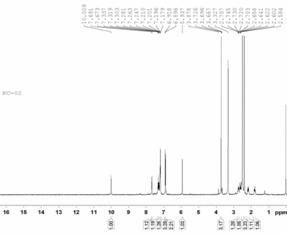
Fig. 2: 1H NMR spectrum of KC-02
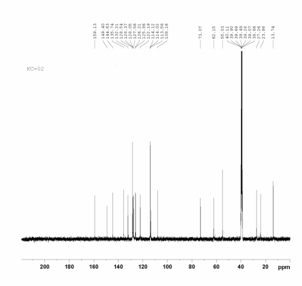
Fig. 3: 13C NMR spectrum of KC-2
Table 1: Physical constants of compounds
|
Compound
Code |
Substitution R |
Molecular Formula |
Mol. weight |
Yield (%) |
|
KC-1 |
-4-Cl |
C22H17ClN4S |
404.09 |
78 |
|
KC-2 |
-4-OCH3 |
C23H20N4OS |
400.14 |
79 |
|
KC-3 |
-4-F |
C22H17FN4S |
388.46 |
78 |
|
KC-4 |
-4-Br |
C22H17BrN4S |
449.37 |
76 |
|
KC-5 |
-3,4-diOCH3 |
C24H22N4O2S |
430.52 |
71 |
|
KC-6 |
-4-CN |
C23H17N5S |
395.48 |
60 |
|
KC-7 |
-3-Cl |
C22H17ClN4S |
404.92 |
77 |
|
KC-8 |
-3-OCH3 |
C23H20N4OS |
400.14 |
76 |
|
KC-9 |
-3-Br |
C22H17BrN4S |
449.37 |
71 |
|
KC-10 |
-4-CH3 |
C23H20N4S |
384.50 |
64 |
bacteria. It is observed from Fig. 3 that KC-10 inhibited 100% while
KC-3 and KC-7 inhibited 75% tested Gram positive bacteria. KC-3 showed maximum zone
of inhibition against Bacillus cereus
(BC).
For Staphylococcus aureus (SA), KC-4 showed maximum inhibition and is followed by KC-3 and KC-10. KC-6 and KC-3 exhibited maximum inhibition against Corynebacterium rubrum (CR) and Listeria monocytogenes (LM) strains, respectively. KC-2, KC-5 and KC-8 could not inhibit any of the Gram positive bacteria. Furthermore, KC-10 could inhibit all these Gram positive bacteria. In all the 10 compounds, the central moiety is Pyrazolo quinazoline with different side chains. There are reports that with same central moiety and with different side chains, the antibacterial activity varies (Baluja et al., 2012; Vaghasiya et al., 2004). Similar results are also observed in the present study. KC-2, KC-5 and KC-8 contain methoxy groups whereas KC-6 and KC-10 contain cyano and methyl groups, respectively, at para positions. The rest of the compounds contain halogen groups (-F, -Cl and –Br) at meta or para positions. Thus, mostly halogen and methyl containing groups are effective in inhibiting these selected Gram positive bacteria. Rai et al. (2008) have reported maximum inhibition due to the presence of methyl and halogen groups. Similar results have also been reported by some other workers (Jantova et al., 2000; Zaranappa et al., 2012). These workers have also observed that in some cases, the presence of halogen groups increases the inhibition. Ibrahim et al. (1997) have also reported that the presence of the –CH3 group as a side chain exhibits a good biological activity. Bacillus cereus (BC) was the most susceptible and Staphylococcus aureus (SA) was the most resistant Gram positive bacteria.
Figure 5 shows antimicrobial activity of compounds against Gram negative bacterial strains. Out of four selected Gram negative bacteria, Escherichia coli (EC) was the most resistant Gram negative bacteria not getting inhibited by any of the tested compounds. For the other three bacterias, KC-9 exhibited maximum inhibition. Against Klebsiella pneumoniae (KP) and Salmonella typhimurium (ST), minimum inhibition is shown by KC-4. Furthermore, KC-5 showed inhibition against Klebsiella pneumoniae (KP) and Salmonella typhimurium (ST) whereas KC-2 could inhibit Pseudomonas aeruginosa (PA).
Again, KC-8 could not inhibit any of these Gram negative bacterial strains. Although all the three compounds, KC-2, KC-5 and KC-8 contain methoxy groups, their positions are different. In KC-2, it is at para position whereas in KC-8, it is at meta position. KC-5 contains two methoxy groups at meta and para positions. Thus, the position of groups also affects the inhibition. This is further supported by comparing inhibition of KC-9 and KC-4. Both of these compounds contain the bromine group but their positions are different. In KC-9, it is at meta position whereas in KC-4, it is at para position. Thus, the position of the group is also important in the bacteria inhibition. Overall, against these selected Gram negative bacteria, the bromine group at meta position is most effective. Thus, Escherichia coli (EC) was the most resistant while Pseudomonas aeroginosa (PA) was the most susceptible bacteria.
For all the selected fungal strains, none of the compound
showed antifungal activity. In the studied compounds, S-CH3 group is
present in the moiety. This may be the reason of why these compounds are
inactive in exhibiting fungal strains. Literature survey shows that most of the
Pyrazolo quinazoline derivatives containing amide or other groups (but not S-CH3
group) showed
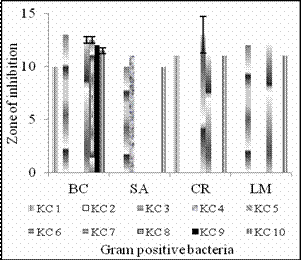
Fig. 4: Antimicrobial activity against Gram positive bacteria.
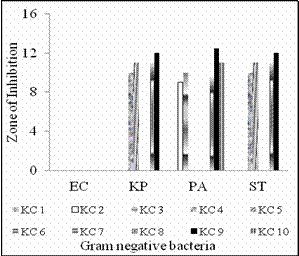
Fig. 5: Antimicrobial activity against Gram negative bacteria.
significant antifungal inhibition (Abdel-Aal
et al. 2010; Antipenko et
al., 2009; Gouda et al., 2010)
Such screening of various organic compounds and the identification of the active agents is essential due to that the successful prediction of a lead molecule and drug-like properties at the onset of drug design will pay off later in drug development.
IV. CONCLUSION
All the 10 compounds showed varied the level of activity against Gram positive and Gram negative bacteria. Overall, compounds containing methyl and halogen groups are more effective in inhibiting the selected Gram positive and Gram negative bacteria. B. Cereus and P. aeroginosa are the most susceptible and S. aureus and E. coli are the most resistant bacteria. Against the selected fungal strains, none of the ten compounds was found to be effective.
REFERENCES
Abdel-Aal, M.T.,
H. Abdel-Aleem, L.I. Ibahim and A.L. Zein, “Synthesis and Antimicrobial
Activity of Novel 5-Amino-4-cyano-1Hpyrazole and Quinazolin-4(3H)-one
Derivatives,” Arch. Pharm. Res., 33, 1891-1900 (2010).
Ali, M.A., M.
Shaharyar and A.A. Siddiqui, “Synthesis, strucyural activity relationship and
anti-tubercular activity of novel pyrazoline derivatives,” Eur. J. Med.
Chem., 42, 268-275 (2007).
Antipenko, L., A.
Karpenko, S. Kovalenko, A. Katsev, E. Porokhnyavets, V. Novikov and A.
Chekotilo, “Synthesis of new 2-thio-[1,2,4]triazolo[1,5-c]quinazoline
derivatives and its antimicrobial activity,” Chem. Pharm. Bull., 57,
580-585 (2009).
Baluja, S., N.
Kacchadia and S. Chanda, “Thiopyrimi-dine derivatives: synthesis and
antibacterial activity,” Pharm. Chem. J., 46, 117-121 (2012).
Bedi, P.M.S.,V.
Kumar and M.P. Mahajan, “Synthesis and biological activity of novel
antibacterial quinazolines,” Bioorg. Med. Chem. Lett., 14,
5211-5213 (2004).
Chandrika, P.M.,
A.R. Rao, B. Narsaiah and M.B. Raju, “Quinazoline derivatives with potent
anti-inflammatory and anti-allergic activities,” Int. J. Chem. Sci., 6,
1119-1146 (2008).
Dangi,
R., N. Hussain, A. Joshi, G. Pemawat and G. Talesara, “Design, facile synthesis
and biological evaluation containing pyrazolothiazolyl, triazinone and their
ethoxyphthalimide derivatives,” Ind. J. Chem., 50(B), 1165-1172
(2011).
Eweas
A.F., A.O.H. El-Nezhawy, A.R. Baiuomy and M.M. Awad, “Design, synthesis,
antiinflammatory, analgesic screening, and molecular docking of some novel
2-pyridyl (3H)-quinazolin-4-one derivatives,” Med. Chem. Res., 22,
1011-1020 (2013).
Gouda,
M.A., M.A. Berghot, G.A. Gheni and A.M. Khalil, “Synthesis and antimicrobial
activities of some new thiazole and pyrzole derivatives based on
4,5,6,7-tetrahydrobenzothiophene moiety,” Eur. J. Med. Chem., 45,
1338-1345 (2010).
Helali,
A.Y.H., M.T.M. Sarg, M.M.S. Koraa and M.S.F. El-zoghbi, “Utility of
2-methyl-quinazolin-4(3H)-one in the synthesis of heterocyclic compounds with
anticancer activity,” Open J. Med. Chem., 4, 12-37 (2014).
Ibrahim,
S.S., A.M. Abdel-Halim, Y. Gabr, S. El-Edfawy and R.M. Abdel-Rahaman,
“Synthesis and biological evaluation of some new fused quinazoline
derivatives,” J. Chem. Res.(S), 5, 154-155 (1997).
Jantova,
S., G. Greif, K. Spirkova, S. Stankovsky and M. Oravcova, “Antibacterial
effects of trisub-stituted quinazoline derivatives,” Folia Microbiol., 45,
133-137 (2000).
Joseph,
A., A. Pai, K.K.Srinivasan, T. Kedar, A.T. Thomas, E. M. Jessy and R.K. Singala,
“Synthesis and anticancer activity of some novel 3-(1,3,4-thiadiazol-2-yl)-quinazolin-4-(3H)-ones,”
Orbital Elect. J. Chem., 2, 158-167 (2010).
Khalil,
A.M., M.A. Berghot and M.A. Gouda, “Synthesis and antibacterial activity of
some new thiazole and thiophene derivatives,” Eur. J. Med. Chem., 44,
4434-4440 (2009).
Kumar,
P., N. Chandak, P. Kaushik, C. Sharma, D. Kaushik, K.R. Aneja and P.K. Sharma,
“Synthesis and biological evaluation of some pyrazole derivatives as
anti-inflammatory-antibacterial agents,” Med. Chem. Res., 21,
3396-3405 (2012).
Kumari,
K., D.S. Raghuvanshi, V. Jouikov and K.N. Singh, “SC(OTf)3-catalyzed,
solvent-free domino synthesis of functionalized pyrazoles under controlled microwave
irradiation,” Tetrahedron Lett., 53,1130-1133 (2012).
Pandey,
V.K., L.P. Pathak and S.K. Mishra, “Synthesis and characterization of
isoquinolinyl quinazolines and a study of their antiviral and antifungal activities,”
Indian. J. Chem. B, 44, 1940-1944 (2005).
Parekh,
J., P. Inamdhar, R. Nair, S. Baluja and S. Chanda, “Synthesis and antibacterial
activity of some Schiff bases derived from 4-aminobenzoic acid,” J. Serb.
Chem. Soc., 70, 1155-1158 (2005).
Patel,
N.B. and G.G. Bharat, “In vitro microbal studies of new pyrazolyl
quinazolin-4(3H) ones,” J. Saudi Chem. Soc., 14, 157-164 (2010).
Patil,
S.S., S.D. Jadhav and M.B. Deshmukh, “Synthesis and antimicrobial activities of
new oxime carbamates of 3-aryl-2-thioquinazoline-4(3H)-one,” J. Chem. Sci.,
124, 1043-1048 (2012).
Pattanaik,
J. M., M. Pattanaik and D. Bhatta, “Synthesis and fungicidal activity of 3-quinazolinones,”
Perez,
C., M. Paul and P. Bazerque, “Antibiotic assay by agar-well diffusion method,” Acta
Biol. Med. Exp., 15, 113-115 (1990).
Rai, N.S.,
B. Kalluraya, B. Lingappa, S. Shenoy and V.G. Puranic, “Convenient access to
1,3,4-trisubstitu-ted pyrazoles carrying 5-nitrothiophene moiety via
1,3-dipolar cycloaddition of sydnones with acetylenic ketones and their
antimicrobial evaluation,” Eur. J. Med. Chem., 43, 1715-1720 (2008).
Riddick,
J.A., W.B. Bunger and T. Sakano, Organic solvents-physical properties and
methods of purification, Fourth Edition., Techniques of Chemistry II, John
Wiley, New York (1986).
Shivananda,
M.K. and B.H. Shivarama, “Antifungal activity studies of some quinazoline
derivatives,” J. Chem. Pharm. Res., 3, 83-86 (2011).
Trivedi,
P.B., N.K. Undavia, A.M. Dave, K.N. Bhatt and N.C. Desai, “Synthesis and
antimicrobial activity of some heterocyclic compounds,” Ind. J. Chem., 32,
497-500 (1993).
Vaghasiya,
Y., R. Nair, M. Soni,
Yassin,
F.A., “Synthesis, reaction and biological activity of 2-substituted 3-cyano-4,6-dimethylpyridine
derivatives,” Chem. Het. Compd., 45, 35-41 (2009).
Zaranappa,
H.M. Vagdevi, N.D. Jayanna and K.P. Latha, “Synthesis, characterization and
evaluation of antibacterial activity of some 3-substitutedphenylquinazoline
-2,4-diones,” Der. Pharm. Chem., 4, 1754-1758 (2012).
Zhang,
Y., Y. Huang, H. Xiang, P. Wang, D. Hu, W. Xue, B. Song and S. Yang, “Synthesis
and anticancer activities of 4-(4-substituted piperazin)-5,6,7-trialkoxy
quinazoline derivatives,” Eur. J. Med. Chem., 78, 23-34 (2014).
Received:
May 2, 2014.
Accepted:
October 31, 2014.
Recommended
by Subject Editor: Octavio Furlong.